.png)

Three fascinating days at the Global Digital Collaboration Conference in Geneva, and the difficulty has clearly moved. Across 159 sessions, almost nobody argued about whether verifiable credentials work. The open question is governance: who decides which issuers are trustworthy, and where that is recorded. Trust registries came up in nearly every room, usually with the same conclusion, that authoritative registers have existed for centuries and the work is making them speak in a verifiable voice. Underneath sat the harder tension, proving something about a person and whether to be able to correlate them across service or not.
Geographic and government
The international spread was the widest I have seen at an event like this. One panel had India, Brazil, Japan, the UK, the European Commission and the OECD on cross-border recognition. Smart Africa argued for sovereign trust, where countries keep control of national systems while agreeing mutual recognition. Singapore and Shanghai showed a working cross-border business registration service. Government presence went well past policy statements, with the European large-scale pilots, France Identité, SPRIND and the Swedish Agency for Digital Government all presenting implementation detail, and UNECE, UNESCO, UNEP and WHO giving the event a multilateral centre of gravity.
Industry and open source
Commercial platforms and open source foundations were working the same problem in the same rooms. Apple presented on trust registries, Google on privacy-preserving pseudonyms, FIDO on agentic commerce. But most of the actual plumbing is being built in the open, by the Linux Foundation, OpenWallet, the OpenID Foundation, W3C, Trust Over IP and GLEIF, running working sessions rather than showcases. The useful signal for anyone in data architecture is that this infrastructure is being specified in public, and is still early enough to influence.
Data and AI for Kids
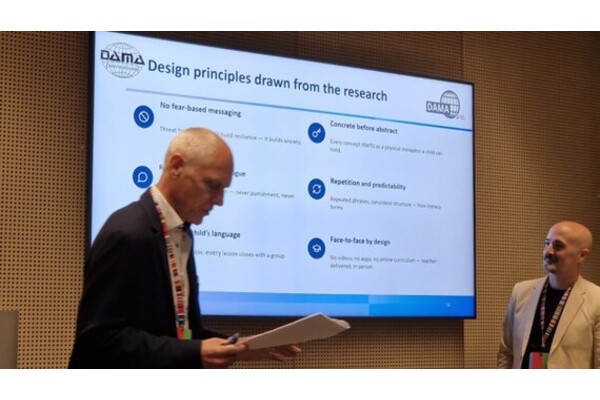
It was an honour to present alongside Frans Klaassen on his initiative to equip teachers with classroom sessions teaching children about data and AI. This sat inside one of the conference's most active strands: age assurance had its own GDC task force update, a global survey and several deep dives across the three days. The prevailing industry approach is that you are a child, and then on a prescribed birthday you are suddenly an adult, which reflects neither developmental stages nor maturity. Frans has curated content that works for six, ten and fifteen year olds, building an anxiety-free understanding of how to protect your data and identity, and of both the benefits and the limitations of AI. The session was very well received, with strong audience engagement throughout.
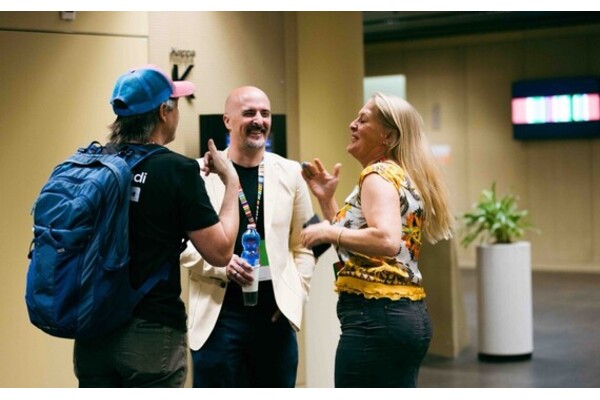
It was great spending time with DAMA Netherlands President Mark, Jaap and Frans and lots of opportunities for current and future collaboration across the chapters has opened up.
Ben Clinch