.png)
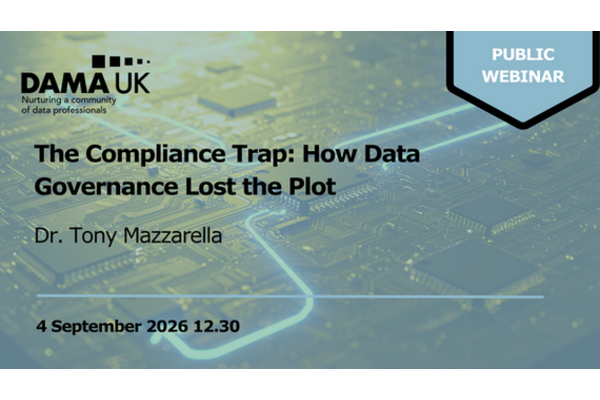

Most of us have the program. We have the policy, the council, the stewards, and the catalog. And a lot of us have the quiet suspicion that none of it is quite working — that the policy nobody reads, the council nobody attends, and the catalog nobody updates aren't really governing anything. We're not imagining it. In a global study of data governance practitioners the artifacts of governance turned out to be nearly everywhere. Whether governance actually happened varied enormously. Having the structure and getting the outcome are two different things.
Here's how we got here. Data governance began as a way to help people coordinate and to agree on what things meant and who decided what. After the financial crisis, regulators changed the incentives, and governance was rebuilt as a defensive control function: prove you complied, document everything, satisfy the auditor. Compliance is a legitimate floor, and in regulated industries it isn't optional. The compliance trap is what happens when it becomes the ceiling — when the entire purpose of the program shrinks to producing evidence, and the program slowly drifts away from the work it was supposed to govern. The artifacts stay. The coordination leaves. Then the reorganization comes, and the program is gone. This session tells that story, shares what practitioners around the world actually said is getting in their way (spoiler: it isn't technology), and makes the case that governance isn't something you install and audit — it's something people do, or don't. Leave with a clearer read on whether your own program is truly working or merely present, and a sense of what makes governance survive the next reorg.
Dr. Tony Mazzarella is a data leader and researcher working at the intersection of data quality, metadata, and governance. He has led large-scale data quality and enterprise data management initiatives across the NGO and financial services sectors, with information quality as the throughline. His research treats data governance as a socio-technical system — shaped as much by incentives and organizational habits as by technology. A former President of DAMA New England and DAMA International board member, he speaks and writes regularly on governing data in the AI era.
Presented on behalf of IRM UK.
